How I Lead
My leadership style is grounded in clarity, candor, and alignment, especially in environments where ambiguity can stall progress. I believe people do their best work when expectations are explicit, psychological safety is real, and outcomes (not politics) guide decisions.
Much of my career has involved stepping into complex systems where teams are navigating competing priorities, regulatory constraints, and unclear ownership. My role in those moments is straightforward: bring clarity to the system so teams can deliver outcomes that matter.
That often means aligning architecture, teams, and operating rhythms so the organization can move with confidence instead of friction. When that happens, complexity becomes manageable and progress accelerates.
Framework: How I Build Clarity in My First 90 Days
How a leader enters an environment sets the tone for everything that follows. My first 90 days focus on understanding the system, both technical and human, and creating the conditions for measurable progress.
7 Days - Connect & Listen
People first, always.
I begin by understanding how my team works: what motivates them, where they’re stuck, and what obstacles they’re facing.
At the same time, I map how decisions actually move through the organization: dashboards, roadmaps, and the meeting rhythms that shape execution.
Before changing anything, I want to understand how the system currently works.
Mantra: “Clear is kind. Unclear is unkind.” — Brené Brown
30 Days - Observe & Analyze
Once the landscape is visible, I dive into the data.
I learn the organization’s “lingua franca” - the acronyms, rituals, and patterns that shape communication.
I examine KPIs, roadmaps, and dependencies to understand where effort aligns with outcomes, and where it doesn’t.
By the end of the first month, I’m rarely asking what is happening anymore.
I’m asking why.
60 Days - Build Foundations
By month two, patterns begin to emerge.
This is where I start introducing structure: quick wins, clarified ownership, and shared goals that help teams understand where they’re strongest and where they need support.
Often the biggest unlock isn’t new technology.
It’s clarity about how the system is supposed to work.
90 Days - Align & Act
The final phase shifts from observation to execution.
Using what I’ve learned (data, relationships, and system dynamics) I align teams around outcomes and introduce systems that sustain clarity and accountability.
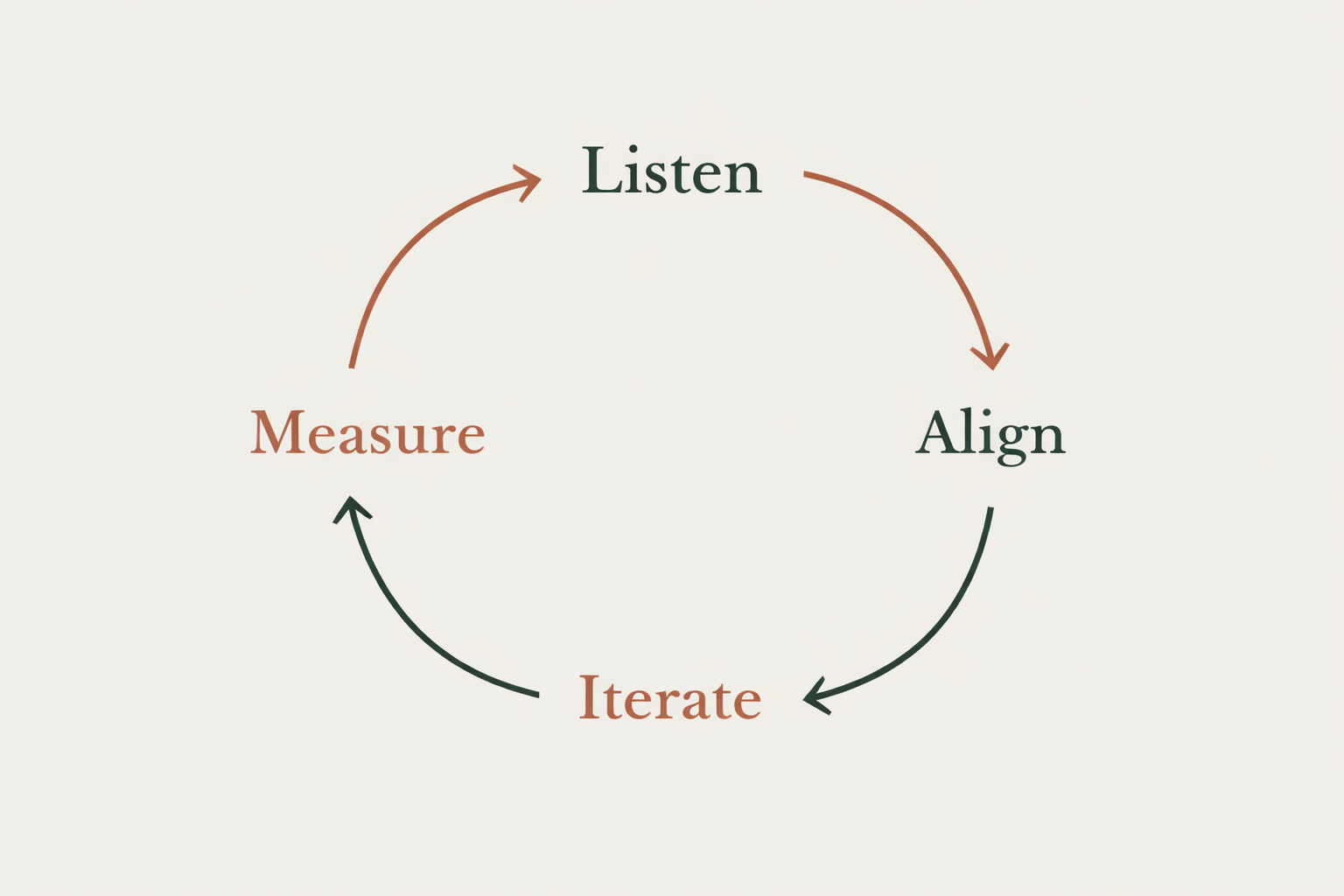
From there the cycle continues:
Listen → Measure → Align → Iterate
Practice: How I Lead Day to Day
1:1s as Coaching, Not Status Updates
My 1:1s are designed for growth, not task tracking.
Each conversation focuses on goals that benefit the individual, the team, and the organization. We review progress transparently and adjust together.
When people understand where they’re going, they move faster.
Psychological Safety Through Candor
Candor and empathy are not opposites - they’re partners.
Teams thrive when feedback is specific, timely, and grounded in trust. I try to model that directly so teams feel comfortable raising risks early and challenging assumptions.
The earlier problems surface, the easier they are to solve.
Decision-Making: Bring People Into the “Why”
Alignment improves dramatically when teams understand context.
I involve cross-functional partners early when framing problems so decisions move faster and execution improves downstream.
Shared understanding reduces friction later.
From Meetings to Momentum
Processes should enable teams, not slow them down.
I streamline recurring meetings, introduce shared dashboards, and create lightweight operating rhythms that keep collaboration alive without burning time.
My test for any process is simple:
Does this help the team move faster with clarity?
If not, we fix it.
Systems: What I Build to Scale Teams
Strong teams need strong systems. Without them, alignment becomes fragile and progress slows.
Over time, I’ve built repeatable structures that help product organizations scale clarity and accountability.
Product University
A mentoring and enablement program designed to scale product thinking across disciplines.
Office Hours
Open coaching sessions that unlock cross-team collaboration and accelerate problem solving.
Executive Summaries
Clear reporting rhythms that keep leadership aligned and reduce noise between layers.
1:1 Growth Framework
A transparent structure for goal-setting and career development.
Each of these systems exists for the same reason:
clarity should be repeatable.
When clarity becomes structural, teams can operate confidently even as environments change.
Culture: How I Build Teams That Thrive
My long game is team culture.
I build teams grounded in trust, shared understanding, and measurable progress. Especially in highly matrixed and poltical organizations, clarity and transparency are the foundation of psychological safety. When people know where the team is going and why, they can challenge assumptions, experiment, and grow.
As a leader, I focus on developing strong product thinkers, encouraging experimentation, and removing friction so teams can do their best work.
Because scaling product excellence ultimately means scaling people.
Closing
Leadership, like product, is iterative.
I listen, test, adapt, and evolve alongside the team because scaling systems (and people) requires the same curiosity and rigor.
Across organizations, platforms, and environments, the goal remains consistent:
build clarity, earn trust, and deliver measurable outcomes.